
Percentage Calculator: Increase, Decrease & Step-by-Step Working
Free percentage calculator for PSLE students. Calculate percentage increase, decrease, find original values, with full step-by-step working shown.
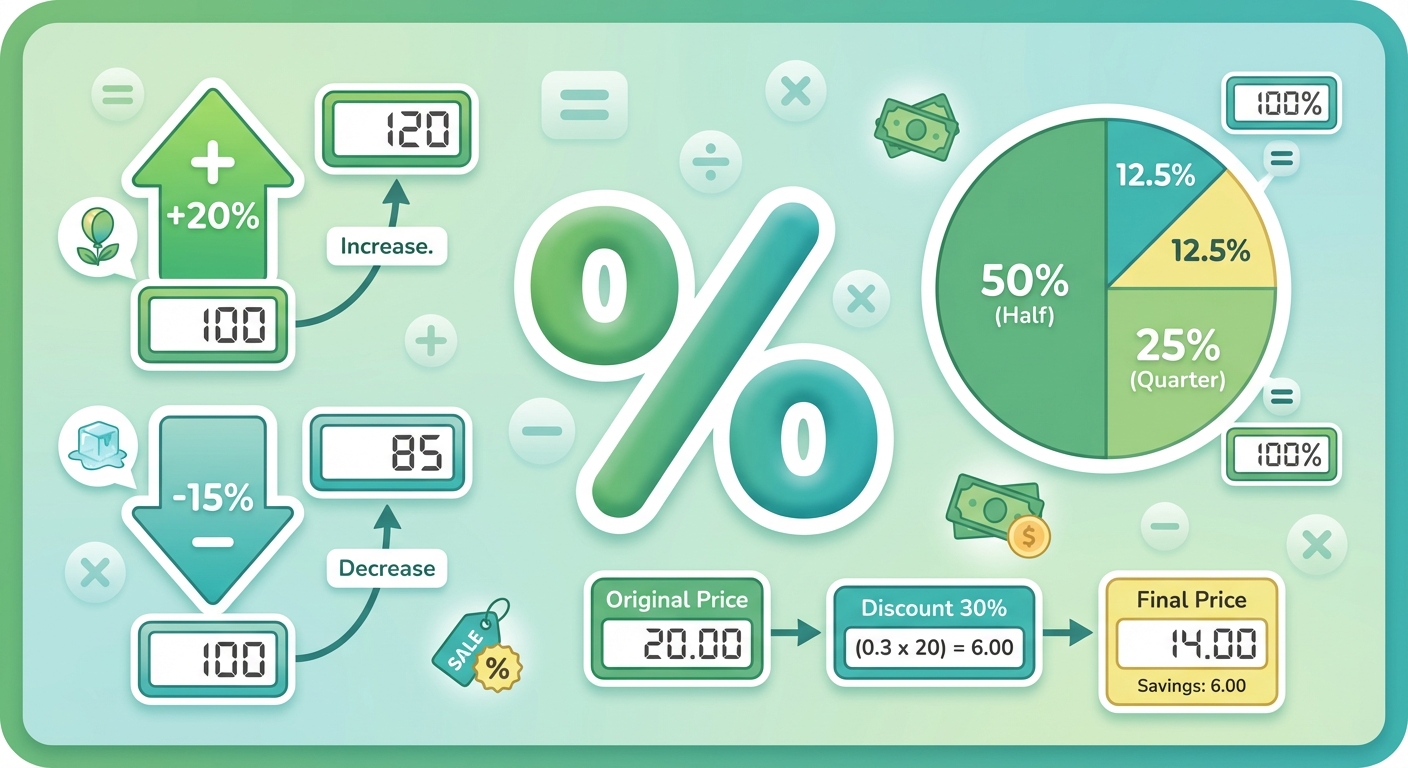
Percentage Calculator with Step-by-Step Working
Calculate percentage increase, decrease, find original values, and more - with full working steps to help you understand and check your PSLE homework!
Calculate Percentages
Select what you want to calculate, enter your values, and see the step-by-step working.
Percentage Calculator
Understanding Percentage Changes
Percentage is one of the trickiest PSLE topics because questions come in many forms. Let’s break down each type.
The Golden Rule: What is 100%?
💡 Always Ask: What is 100%?
In every percentage problem, 100% represents the original value (the starting point).
- After a 20% increase, the new value = 120% of original
- After a 20% decrease, the new value = 80% of original
Type 1: Percentage Increase
Question type: “A shirt costs $40. After a 25% increase, what is the new price?”
Method 1: Two-Step Method
Method 2: One-Step Method (Faster!)
💡 One-Step Shortcut
For increases: multiply by (100 + percentage) ÷ 100
- 10% increase → × 1.10
- 25% increase → × 1.25
- 50% increase → × 1.50
Type 2: Percentage Decrease
Question type: “A bag costs $80. During a 30% sale, what is the sale price?”
Method 1: Two-Step Method
Method 2: One-Step Method (Faster!)
💡 One-Step Shortcut
For decreases: multiply by (100 − percentage) ÷ 100
- 10% decrease → × 0.90
- 25% decrease → × 0.75
- 30% decrease → × 0.70
Type 3: Finding the Original (Reverse Percentage)
This is where most students struggle! The question gives you the final value and asks for the original.
After an Increase
Question type: “After a 20% increase, a TV costs $600. What was the original price?”
⚠️ Common Mistake
WRONG: 600 = 120 = $480 ❌
This is wrong because 20% should be of the original, not $600!
Correct Method:
After 20% increase: Final = 120% of Original
Or using the formula:
After a Decrease
Question type: “After a 25% discount, a dress costs $150. What was the original price?”
After 25% decrease: Final = 75% of Original
Or using the formula:
Type 4: Finding the Percentage Change
Question type: “The price increased from 60. What is the percentage increase?”
Formula
Worked Example
❌ Critical: Divide by ORIGINAL
Always divide by the original value, not the new value!
- If price goes from 60: divide by $50 (original)
- If price goes from 50: divide by $60 (original)
Type 5: Finding Percentage Of
Question type: “Find 35% of 240.”
Method 1: Direct Calculation
Method 2: Break Into Parts
For tricky percentages, break them into easier parts:
Percentage Shortcuts to Memorize
| Percentage | Shortcut | Example: % of 80 |
|---|---|---|
| 10% | ÷ 10 | 80 ÷ 10 = 8 |
| 20% | ÷ 5 | 80 ÷ 5 = 16 |
| 25% | ÷ 4 | 80 ÷ 4 = 20 |
| 50% | ÷ 2 | 80 ÷ 2 = 40 |
| 5% | ÷ 20 (or 10% ÷ 2) | 8 ÷ 2 = 4 |
| 1% | ÷ 100 | 80 ÷ 100 = 0.8 |
| 75% | × 3 ÷ 4 | 80 × 3 ÷ 4 = 60 |
PSLE Worked Examples
Example 1: Price After Discount
Problem:
A laptop costs $1,200. During a sale, the price is reduced by 15%. What is the sale price?
Method 1 (Two-Step):
Discount amount = 15% × 1,200 × 15 ÷ 100 = $180
Sale price = 180 = $1,020
Method 2 (One-Step):
Sale price = 1,200 × 0.85 = $1,020
Example 2: Find Original After Increase
Problem:
After a 25% pay raise, John earns $5,000 per month. What was his salary before the raise?
After 25% increase, the new salary represents 125% of the original.
125% → $5,000
1% → 40
100% → 4,000**
Check: 4,000 = 1,000 = $5,000 ✓
Example 3: Two Successive Changes
Problem:
A shop increases prices by 20%, then offers a 20% discount. If an item originally cost $100, what is the final price?
Step 1: After 20% increase
New price = 120
Step 2: After 20% discount
Final price = 96**
⚠️ Not $100!
Many students think +20% then −20% gives back 120, not $100!
Example 4: Combined GST and Discount
Problem:
A meal costs $80 before GST. After adding 9% GST, a 10% member discount is applied. What is the final bill?
Step 1: Add 9% GST
Price with GST = 87.20
Step 2: Apply 10% discount
Final bill = 78.48**
Common Mistakes to Avoid
❌ Mistake 1: Wrong Base for Reverse Problems
When finding the original after an increase/decrease, don’t calculate % of the final value!
Wrong: Original = 600 ❌ Right: $600 represents 120%, find 100% ✓
❌ Mistake 2: Adding/Subtracting Percentages Directly
A 20% increase followed by 20% decrease does NOT equal 0% change!
The second percentage applies to the NEW value, not the original.
❌ Mistake 3: Dividing by New Instead of Original
When finding percentage change, always divide by the ORIGINAL value.
60 is a 20% increase (divide by 50) 50 is a 16.67% decrease (divide by 60)
❌ Mistake 4: Forgetting to Convert % to Decimal
25% means 25 ÷ 100 = 0.25, not 25!
25% of 80 = 0.25 × 80 = 20 (not 2000!)
Quick Reference Card
| Problem Type | Formula |
|---|---|
| Find X% of Y | Y × X ÷ 100 |
| Increase Y by X% | Y × (100 + X) ÷ 100 |
| Decrease Y by X% | Y × (100 − X) ÷ 100 |
| Original (after X% increase) | Final ÷ (100 + X) × 100 |
| Original (after X% decrease) | Final ÷ (100 − X) × 100 |
| % change from A to B | (B − A) ÷ A × 100% |
More PSLE Resources
- PSLE Percentage: Why Students Struggle and How to Master It
- Top 10 Careless Mistakes in PSLE Math
- PSLE Math Checking Strategy: Stop Losing Easy Marks
Master Percentages with AI Practice
Practice percentage problems with instant feedback and hints from our AI tutor.
Start Practicing Now